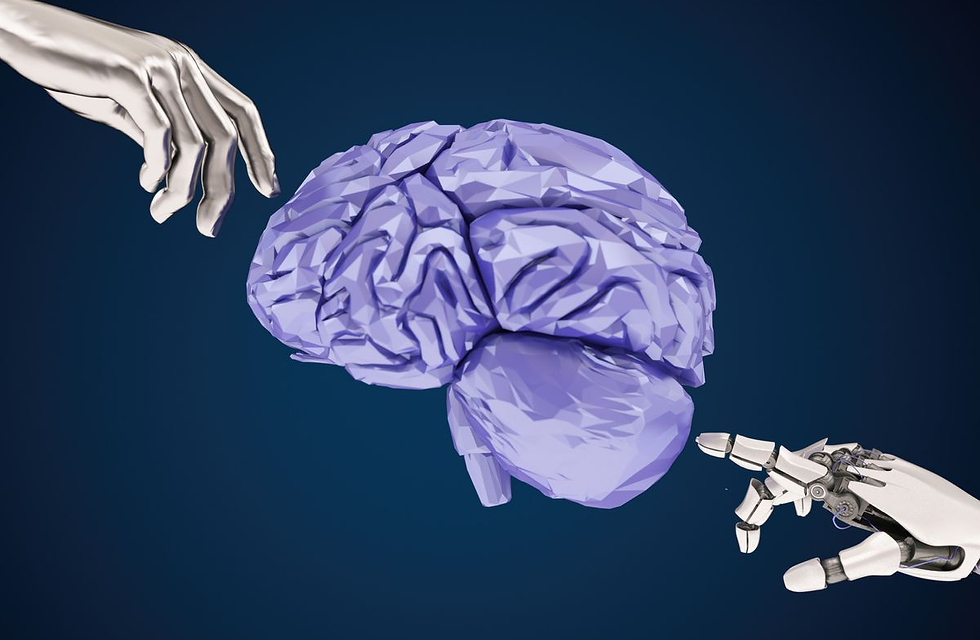
The Newest in Brain Computer Interfaces
Sophie Bilanin '26 & Simi Rath '26
Mind reading: those two words conjure images of unrealistic fantasy, a concept that used to only exist within books and TV. Yet this seemingly futuristic notion is closer to becoming a reality through the production of devices called brain-computer interfaces, or BCIs. These machines serve as a bridge from the brain to an external apparatus by connecting either an active neuron or group of neurons to the device, in turn translating the brain’s electrical signals into processable data (Birbaumber, 2006). The creation and study of these machines have become increasingly prominent throughout the neuroscience field within the last twenty years, with their main purpose being to assist disabled persons with communication or movement. The astonishingly swift pace at which BCIs have been developing for the past few decades indicates a future full of opportunities for the machine’s usage.
BCIs can be connected to the brain through either wearable or implanted devices. Wearable BCIs are caps containing electroencephalographic sensors that detect electrical impulses and currents in the brain. This method often provides less precise computer control than implanted devices. But a developing form of wearable BCIs, known as functional near-infrared spectroscopy, or fNIRS, has provided other enhanced features. fNIRS measures blood flow by shining light through the skull, which can reveal otherwise inaccessible information such as the user’s intentions.
Implanted BCIs can include devices surgically attached to brain tissue or electrocorticographic devices, ECoG, which comprise placing electrodes on the brain’s exterior. These BCIs allow for the connection of specific neurons and are more suitable for controlling limbs than wearable BCIs. Nevertheless, implants can be rejected by the brain or become infected, leading to many possible health risks (U.S.G.A.O., 2022).
Today, BCI research and development has become a competitive market. The assets under management for this industry currently reside at a shocking 211.1 billion dollars due to the establishment of large companies with sole purposes of BCI production, including Elon Musk’s Neuralink and EMOTIV (B. C. I. M., 2022). After testing implanted BCI chips in mice, monkeys, and pigs, Neuralink announced in August 2020 that it plans to start human trials before the end of 2022 to allow quadriplegic people to control a computer cursor. Musk has been working with neurologists to design a “sewing machine” surgical robot named “V2” to implant the BCI in a human brain in under an hour without anesthesia. After an incision is made in the skin and a portion of the skull is removed by a neurosurgeon, the robot inserts the neural chip, which is the size of a large coin, and the wire-attached electrodes. The surgeon then fixes the implant so that it takes the place of the removed skull piece and closes the incision (Wiggers, 2020).
EMOTIV, on the other hand, sells wearable BCI caps online for about 2,000 dollars. These products pair with computer devices using Bluetooth, and, depending on the product, either control the computer device, transmit information on brain activity and mechanisms, or use a 3D brain visualizer to create an image of the four major brain frequencies in action. According to their website, EMOTIV uses three different detection algorithms to analyze neural behavior. The first comprises measuring the user’s excitement, interest, frustration, attention, and relaxation in real time. The second involves using EEG technology for the recognition of mental commands, which the EMOTIV website claims their systems can learn to do in less than twenty seconds. The third method involves monitoring facial expressions, as well as eye and muscle movements (EMOTIV, n.d.).
Aside from BCI production, most BCI research is conducted at universities. For example, a recent study conducted by the USC Viterbi School of Engineering pursued the use of generative adversarial networks (GANs) technology to create synthetic neural data points to simplify the BCI training process. BCI technologies require extensive quantities of neural data for inputs to be correctly processed, and attaining this amount of information is a difficult, time-consuming task. Therefore, using GANs to create “mental deep fakes” that simulate brain processes and mechanisms can both accelerate and simplify BCI training at up to twenty times the prior speed (Fernandez, n.d.).
The humble beginnings of BCI technology date back to 1969 when former professor Jaques Vidal of the University of California (UCLA) delivered the first-ever peer-edited works concerning this development. Initially tested on monkeys, the power of BCIs has grown significantly over the last half-century and has evolved into an indispensable tool for assisting the disabled. Originally, BCIs were created for the sole purpose of helping paralyzed people enhance their motor skills; however, BCIs are now being used to enhance cognitive capabilities for all of the population, specifically in the workplace (Gonfalonieri, 2020).
Muse, a small company focused on neurological interface research, has developed a headband that detects and decodes neural signals into live data regarding the happenings in the wearer’s brain (Gonfalonieri, 2020). This newfound ability to transform neural messages into understandable data points will certainly give rise to countless new opportunities, especially in the modern workforce. For example, companies can now find themselves in tune with the attention, stress, and emotional levels of their employees, which promotes productivity, insight, and improved communications. Additionally, BCIs are beginning to help eradicate machinery-related dangers. In the future, BCIs could be worn when driving to detect drowsy or intoxicated drivers. According to the National Highway Traffic Safety Administration, over 100,000 police-detected accidents caused by fatigued drivers occur yearly in the United States (National Security Council, n.d.). BCIs could help to prevent these accidents, saving countless lives.
In describing these areas of possible expansion, however, it is critical to acknowledge the many security and ethical concerns that come with such cutting-edge technology. Aside from the aforementioned health troubles caused by BCI implants, BCIs pose a threat to individuals’ mental privacy. Thoughts can be translated through the use of this technology without consent, neural data can be abused, and, worst of all, a person can attempt to hack into another’s brain. Just like any other technology, BCIs are not flawless, but, if used properly, can make a monumental impact on our society.
BCI technologies contribute immensely to the field of neuroscience by opening numerous possibilities for society. From providing disabled people with life-quality improvements to expanding intrapersonal knowledge and communication, BCIs are continuing to serve as game-changers. While there are indeed risks and precautions that come with the implementation of these devices, they provide benefits that allow for deeper human connections and psychological understanding.
References
Birbaumer, N. (2006). Breaking the Silence: Brain-Computer Interfaces (BCI) for Communication and Motor Control. Psychophysiology, 43(6), 517–532. https://doi.org/10.1111/j.1469-8986.2006.00456.x
Corp, B.-B. C. I. M. (2022, July 21). BCI Announces 7. 4 Percent Annual Return for Fiscal 2022. GlobeNewswire NewsRoom.
https://www.globenewswire.com/news-release/2022/07/21/2483691/0/en/BCI-ANNOUNCES-7- 4-PER-CENT-ANNUAL-RETURN-FOR-FISCAL-2022.html
EMOTIV. (n.d.). EMOTIV | Brain Data Measuring. https://www.emotiv.com/
Fatigued Driving. (n.d.). Retrieved October 18, 2022, National Security Council https://www.nsc.org/road/safety-topics/fatigued-driver#:~:text=The%20National%20 Highway%20 Traffic%20Safety,fatalities%20and%20about%2050%2C000%20injuries
Fernandez, E. (n.d.). Benefits of “Deepfaking” the Mind in Creating Brain-Computer Interfaces. Forbes. Retrieved October 19, 2022, from https://www.forbes.com/sites/fernandezelizabeth/2021/11/30/benefits-of-deepfaking-the-mind-in -creating-brain-computer-interfaces/
Gonfalonieri, A. (2020) What brain-computer interfaces could mean for the future of work, Harvard Business Review. Retrieved October 15, 2022. https://hbr.org/2020/10/what-brain-computer-interfaces-could-mean-for-the-future-of-work
Our Technology. (n.d.). EMOTIV. Retrieved October 19, 2022, from https://www.emotiv.com/our-technology/
U. S. G. A. O. (2022). Science & Tech Spotlight: Brain-Computer Interfaces. Retrieved October 19, 2022, from https://www.gao.gov/products/gao-22-106118
Wiggers, K. (2020, August 28). Neuralink Demonstrates its Next-Generation Brain-Machine Interface. VentureBeat.
https://venturebeat.com/ai/neuralink-demonstrates-its-next-generation-brain-machine-interface/