Australia's Rainforests are Releasing More Carbon Than They Absorb
Kate Wei '28
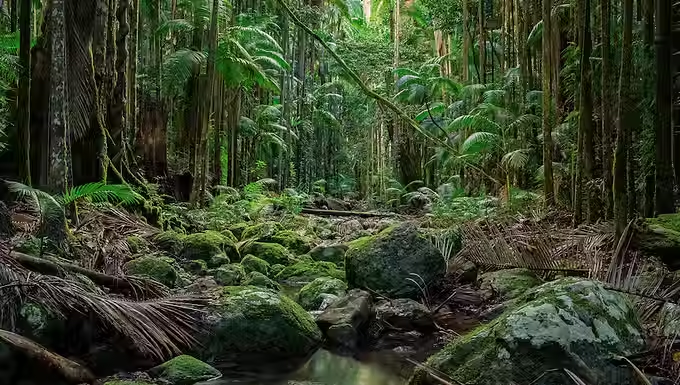
From Carbon Sinks to Carbon Emitters: The Remaking of Australia’s Rainforests Kate Wei ’28
Australia’s tropical rainforests have long played an important role in slowing global warming by absorbing carbon dioxide, a greenhouse gas, from the air and storing it in trees and plants through photosynthesis. This stored carbon is found mostly in woody biomass, which includes tree trunks, branches, and roots. For many years, Australia’s forests acted as carbon sinks, removing more carbon from the atmosphere than they released. However, scientists recently discovered that many of Australia’s rainforests are actually releasing more carbon than they absorb, making them carbon sources rather than sinks (Carle et al., 2025).
Notably, this transformation is happening in the Wet Tropics region of Queensland. Located on the northeastern coast of Australia, this region contains some of the oldest and most diverse rainforests in Australia (ANU, 2025). Based on data collected since the early 2000s, researchers found that the total amount of living tree biomass has decreased over time (Carle et al., 2025). As trees die and decompose, the carbon stored inside them is released back into the atmosphere as carbon dioxide. This results in more greenhouse gases trapping heat in the atmosphere, accelerating climate change.
A primary source for the decrease of living trees in these forests is rising temperature. Australia has warmed by about 1.5°C (2.7°F) since 1910, and heat waves are becoming more common (Carle et al., 2025). Trees in tropical rainforests are accustomed to the warm weather, but extreme heat puts them under stress. When temperatures rise too high, trees have trouble transporting water to maintain their cellular functions, increasing the risk of mortality (Carle et al., 2025). Additionally, rising temperatures also pulls moisture out of Australia’s trees, causing the trees to lose water faster and to close their stomata to avoid drying out (Carle et al., 2025). When the leaf openings close, trees take in less carbon dioxide, which slows their growth and their carbon-capturing ability. Weaker, stressed trees are also more likely to die, which leads to even more carbon being released.
Strong storms called cyclones also damage rainforest trees, as they can snap tree trunks, knock down large trees, and remove branches. The dead wood then breaks down and releases carbon dioxide into the air, which reduces the amount of carbon stored in the forest (ANU, 2025). Over the past few decades, several powerful cyclones have hit the Wet Tropics region, causing long-lasting damage to forest’s ability to act as a carbon sink (Carle et al., 2025).
Scientists once believed that higher levels of carbon dioxide in the atmosphere would help trees grow faster, which is known as the carbon fertilization effect (IPCC, 2023). While this occurrence can happen in lab experiments, real forests face many other limits, such as discrepancies in optimal heat, water, and soil nutrient concentration. In Australia’s rainforests, any extra tree growth from the additional carbon dioxide in the air has not been enough to make up for the stored carbon released back into the atmosphere from dying trees and storm-damaged branches (Carle et al., 2025). This situation, in turn, creates a positive feedback loop: warmer temperatures kill more trees, dead trees release more carbon, and the extra carbon causes temperatures to rise more (IPCC, 2023).
The transformation of Australia’s forests into carbon emitters rather than carbon sinks challenges how the world currently handles climate change. Many governments and businesses expect forests to keep absorbing carbon to offset human pollution. If forests start releasing carbon instead, the general public’s plans and expectations become less reliable (IPCC, 2023). Australia’s rainforests show that people cannot always depend on natural ecosystems to counter the damage caused by fossil fuel use. The deterioration of Australia’s rainforests serves as a warning sign for scientists by proving that climate change has already damaged even the strongest ecosystems (Carle et al., 2025). If global warming continues, more forests around the world could also stop storing carbon and start emitting it, making climate change harder to control.
References
Australian National University. (2025). Australia’s rainforests first to switch from carbon sink to Source.
https://science.anu.edu.au/news-events/news/australias-rainforests-fIrst-switch-carbon-sin k-source?utm_source=chatgpt.com
Carle, H., Nicotra, A. B., & colleagues. (2025). Aboveground biomass in Australian tropical forests now a net carbon source. Nature.
https://www.nature.com/articles/s41586-025-094 97-8.
Intergovernmental Panel on Climate Change. (2023). Climate change 2023: Synthesis Report. https://www.ipcc.ch/