Coral Depletion and Why It Matters
Anne Clifford-Levy '26
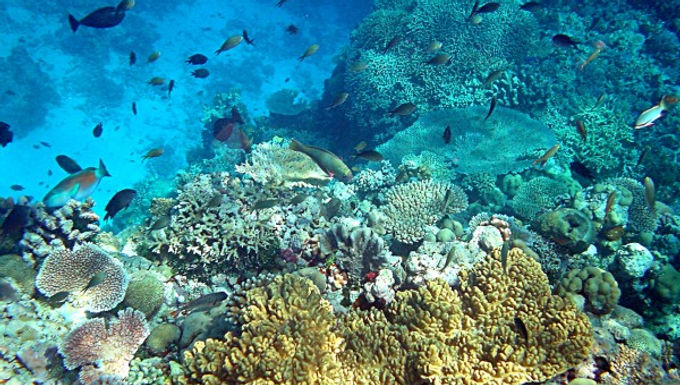
Coral reefs are incredibly important for both marine life and people living in coastal areas. Although they only cover 0.2 percent of the ocean floor, they house, provide food for, and generally benefit 25 percent of all marine species (UN, 2021). As coral reefs are home to so many organisms and are a part of many coastal ecosystems, they are an unparalleled promoter of biodiversity. Every marine species, from fish to snails, feeds on the inner tissues of each individual coral polyps, and even more animals, like crabs, clams, and sea urchins, use coral reefs as protection against their natural predators. When coral starts dying, algae becomes increasingly abundant, leading to a decrease in this significant attribute of marine biodiversity because algae cannot support organisms to the same extent as coral. People living by these reefs are also positively impacted by them. Coral reefs not only serve as storm protection by acting as a buffer between the storm and land, but they have also created a multitude of jobs, boosted local economies, and are a component of many modern medicines. Because these reefs lead to worldwide tourism, fishing success, and much more, they are responsible for $100 million to U.S. fisheries and $9.9 trillion in the global economy (NOAA, Earth Day Network). Just how important coral reefs are to this planet cannot be overlooked.
With our need for coral reefs comes the importance of keeping them safe and healthy, but that job has become increasingly difficult in past years because of the many negative environmental and social factors plaguing them. Climate change is the leading factor against coral health, leading to ocean acidification, chemical run-off in the ocean, and sea surface temperature rise. Ocean acidification occurs when there is an increase in carbon dioxide in the atmosphere, resulting in a decrease in water’s pH levels; additionally, chemical run-off has become more common due to an increase in precipitation , and more extreme flooding. When these stressors start affecting the coral, it will release the algae, zooxanthellae, from its tissues. This process is known as coral bleaching: the coral will turn white when it no longer has nutrients to live, leading to the depletion and inevitable ending of vital resources for thousands of species (NOAA). Mass tourism also plays a role in coral loss, from the practice of breaking parts of living coral for sale to the sunscreen worn by tourists. Most sunscreens contain the chemical oxybenzone, which, when swimming, can transfer into the water and harm coral growth and its reproductive abilities (National Geographic, 2023).
Coral extinction is becoming an increasingly urgent matter. From 2009 to 2021, there was a 14 percent decrease in coral worldwide. That percentage is more than all of the coral living in Australia, and it is only exacerbated by algae growth – a 20 percent increase of the organism was recorded between 2010 and 2019. Because algae has a tendency to wrap around coral, limiting its access to the sun and preventing it from further growth, algae abundance often represents coral depletion. Lastly, if we do not limit global warming to 1.5°C, we could lose anywhere from 70 to 90 percent of all coral (UN, 2021).
Some people and places have started implementing laws to combat this drastic coral depletion. In Hawaii, for example, the sale of sunscreen containing harmful chemicals like oxybenzone was banned. Additionally, in October of 2023, the International Coral Reef Initiative agreed to raise over $12 million in funding for coral reef protection. This group is made up of nations from around the world, including Australia, Japan, France, Jamaica, and the USA (Reuters, 2023). Although these are two examples of large organizations and governments affecting change, it is also important to note that each individual has the ability to make a positive impact on coral health. When in tropical areas, be more mindful of the chemicals you are interacting with because they will always end up in the ocean; stay informed about what is going on; understand how you and the people around you are benefitting from coral every time you eat seafood or swim in diverse waters.
References
Basic information about coral reefs. (2023, May 11). Environmental Protection Agency. Retrieved January 15, 2024, from
https://www.epa.gov/coral-reefs/basic-information-about-coral-reefs#:~:text=Coral%20re efs%20provide%20habitat%20for,and%20many%20species%20of%20fish.
Coral reefs. (n.d.). Earth Day. Retrieved January 15, 2024, from
https://www.earthday.org/wp-content/uploads/species/coralreefs.pdf
Gallessich, G. (2006, June 12). Coral death results from bacteria fed by algae. The Current. Retrieved January 15, 2024, from
https://news.ucsb.edu/2006/012146/coral-death-results-bacteria-fed-algae#:~:text=%22Al gae%20release%20sugar%2C%20fueling%20bacterial,for%20more%20algae%20to%20 grow.
How do coral reefs benefit the economy? (n.d.). National Ocean Service. Retrieved January 15, 2024, from
https://oceanservice.noaa.gov/facts/coral_economy.html#:~:text=Healthy%20coral%20re efs%20contribute%20to,by%20pollution%20and%20climate%20change.
Rising sea surface temperatures driving the loss of 14 percent of corals since 2009. (2021, October 5). UN Environment Programme. Retrieved January 15, 2024, from https://www.unep.org/news-and-stories/press-release/rising-sea-surface-temperatures-driv ing-loss-14-percent-corals-2009#:~:text=Nairobi%2C%205%20October%202021%20%2 D%20The,the%20world's%20coral%20since%202009.
Stanway, D. (2023, October 3). Countries pledge to raise $12 billion to fund coral reef protection. Reuters. Retrieved January 15, 2024, from
https://www.reuters.com/sustainability/sustainable-finance-reporting/countries-pledge-rai se-12-billion-fund-coral-reef-protection-2023-10-03/
What is coral bleaching? [National Ocean Service]. (2023, October 4). Retrieved January 15, 2024, from
https://oceanservice.noaa.gov/facts/coral_bleach.html#:~:text=Warmer%20water%20tem peratures%20can%20result,This%20is%20called%20coral%20bleaching. Why are coral reefs dying? (2021, November 12). UN Environment Programme. Retrieved January 15, 2024, from
https://www.unep.org/news-and-stories/story/why-are-coral-reefs-dying
Zachos, E., & Rosen, E. (2023, June 2). What sunscreens are best for you—and the planet? National Geographic. Retrieved January 15, 2024, from
https://www.nationalgeographic.com/travel/article/sunscreen-destroying-coral-reefs-alter natives-travel-spd#:~:text=The%20sunscreen%20problem,cycles%2C%20ultimately%20 leading%20to%20bleaching.