The Open Face Turkey Sandwich: Unseen Causes of Climate Change
Zikang Jiang '25
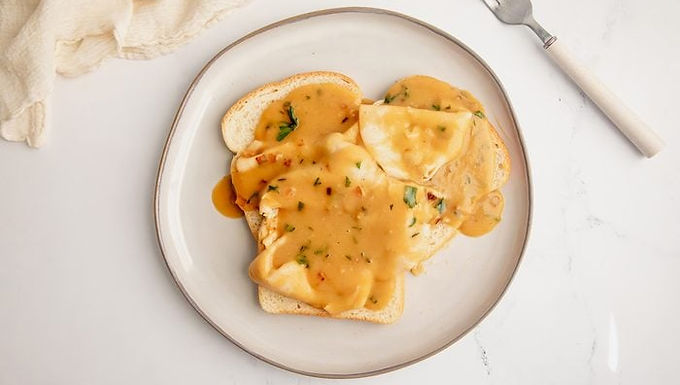
It’s lunch and the usual throngs of hungry students surrounding the counter, waiting not so patiently to inhale a plateful of fries that are noticeably absent. The countertop remains blissfully clean and unspoiled by the usual scraps of food dropped by students jostling for optimal positioning in the line. It's lunch, and it's the open-face turkey sandwich. The trays are untouched, the mashed potatoes unspoiled, the slices of turkey undisturbed, lined in neat unbroken rows, and the bags of wheat bread unopened. This is food waste, but only a small fraction of it.
Daily, people all over the globe scrape plates filled with untouched food into the trash, households forget about that formerly fresh bag of tomatoes hidden in a corner of the fridge, cafes, bakeries, and restaurants trash their unsold goods, grocery stores reject perfectly edible produce because of visual defects, and farmers lose acres of crops. Specifically, the US wastes ~33% of all food produced in the country, totaling 77.6 million tons of food waste, the equivalent of 145 billion meals, and worth $428 billion (ReFED, n.d). Such uneaten food is responsible for 6.1% of US GHG emissions, 16% of US cropland use, and 22% of US freshwater use. This insane mountain of waste somehow exists while 1 in 8 Americans are food insecure (ReFED, n.d). Globally, if food waste was a country, it would be the 3rd largest emitter of greenhouse gasses behind China and the United States (ReFED, n.d).
However, this problem isn’t due to a lack of attention or innovative solutions. It’s also not caused by picky eating, where people just refuse to eat that turkey sandwich. A brief search reveals thousands of innovations meant to prolong the shelf life of foods and even more companies that conduct gleaning, food rescue, composting, and awareness campaigns, among many more innovative solutions. Apeel, a company that significantly increases the shelf life of produce, utilizes another plant-based layer, a “peel”, to help produce retain water and prevent oxidation (Apeel, n.d). Mill, a company that has “revolutionized” the humble trash can, provides in-home composting with their contraption capable of composting 1lb of wasted food in 2.5 hours compared to the weeks and even months needed for conventional composting methods (Mill, n.d). The organization Feeding America, perhaps the most well-known food rescue group, provides a nationwide network of food pantries to both receive and distribute excess food. These are some solutions that have helped prevent hundreds of millions, if not billions of pounds of food from entering landfills and incinerators.
Yet, given the plethora of available solutions, why does the US alone still waste 77.6 million tons of food? How are over 41 million Americans still food insecure? Well, going back to the turkey sandwich, just because some students prefer going to war over curly fries doesn’t mean there is no demand for the turkey sandwich with its healthy wheat bread, high protein content, and buttery mashed potatoes. Perhaps at the Hill School, it can find its beloved home. But that’s precisely it, there is demand for such a commodity. If located elsewhere, it would be utilized optimally, producing no waste and no extra work for the dining staff. This is a microcosm for food waste management in the US, where those with wasted food and edible excess food—households, restaurants, and grocery stores among others—are not conveniently and cost-effectively connected, or often not connected at all, with those with a demand for it—food banks, compositing companies, individuals, and many more. Millions of tons of turkey sandwiches are produced in locations with no need for them, while throughout the country in places unknown to those turkey sandwich aficionados lie millions who would gladly enjoy such a meal.
The solution, though difficult to implement, is obvious. The creators and potential recipients of the turkey sandwich simply need to know of each other's existence, each other’s supply and demand, and be provided with a convenient way to transport the food, for there to be no leftovers. This same principle of optimization through providing ample information and connectivity can be applied to all aspects of food waste, allocating inedible wasted food to composting companies, providing transportation capacities to food banks, connecting investors with innovative food waste prevention companies, among many more possibilities. Simply, an information platform connecting all parties involved with food waste is needed to optimize its management by matching supply and demand and maximizing the use of individual resources.
References
Food waste problem | refed. (n.d.). Retrieved March 16, 2024, from
https://refed.org/food-waste/the-problem/
How apeel works | learning from nature | apeel. (n.d.). How Apeel Works | Learning From Nature | Apeel. Retrieved March 16, 2024, from
https://www.apeel.com/undefined/how-apeel-works
The bin that wastes nothing | Mill. (n.d.). Retrieved March 16, 2024, from https://www.mill.com/food-recycler