Unusual Migration Patterns of Gray Whale into San Francisco Bay
Elena Shen '29
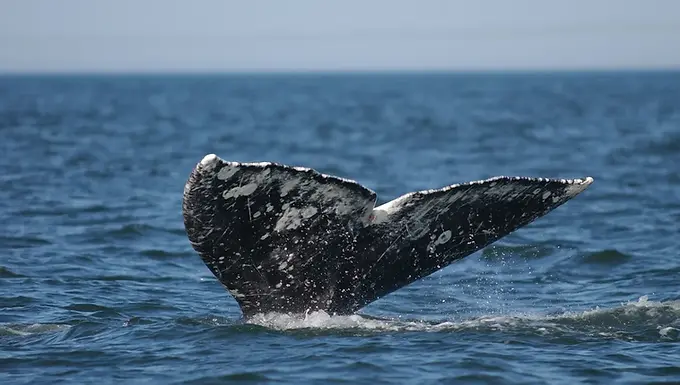
The population of Eastern North Pacific (ENP) gray whales has been negatively impacted by recent temperature changes in the Northern Pacific that cause the population of their prey to decrease. The NOAA declared an unusual mortality event, meaning a mass mortality of a marine animal population that requires immediate response, for ENP whales from 2019-2023, over which a 46% population decline occurred. Afterward, the population continued to decrease, and by 2025, there had been over a 50% decline from its peak in 2016 (Slaathaug et. al, 2026).
ENP gray whales live near the coasts and feed on amphipods, a type of crustacean. Every year, they migrate to Baja California, Mexico, a 15,000-20,000 km round-trip, to breed in its warm lagoons (Swartz, 2017). Gray whales rely on their fat stores for the great amount of energy this trip requires. Usually, as gray whales migrate to and from tropical breeding grounds, they do not feed and instead sustain themselves on the amphipods in Arctic feeding areas. A warming climate disturbs these feeding areas, preventing the whales from getting the food they need to store energy. As a result, they must make stops along their migration route to replenish their energy.
Starting in 2018, as food supply further diminished in the Arctic, ENP gray whales started appearing more frequently in San Francisco Bay, where they face danger in boat interactions. According to Josephine Slaathaug of Sonoma State University, lead author of an article in Frontiers in Marine Science in which researchers examined gray whale mortality in SF Bay, "Gray whales have a low profile to the water when they surface, and this makes them difficult to see in conditions like fog, which are common to San Francisco Bay”. Gray whales are challenging to spot from boats, and these vessels struggle to avoid them which commonly results in collisions. Furthermore, she states that “Golden Gate Strait serves as a bottleneck through which all traffic and whales must enter and exit,” forcing unsafe encounters between the whales and vessels. Boats are not adequately prepared to navigate around gray whales, and the landscape of SF Bay creates proximity and forces interactions between the whales and vessels, putting the animals at risk.
The researchers were able to build a database of whales in San Francisco Bay, using photo identification from 2018-2025 through vessel-based surveys, opportunistic effort, and community submissions. From 2023-2025, they utilized dedicated surveys to predict spots for photo identification. They were able to identify 114 individual whales, only eight of which belonged to a preexisting foraging subgroup, showing how changing temperatures are forcing more whales to expand their habitats. Throughout different years, only four whales were resighted, suggesting the stop is not part of a routine, but more of an emergency stop for whales low on energy (Slaathaug et. al, 2026).
Using this photo identification, the researchers matched whales to carcasses and found that at least 18% of the whales that had entered SF Bay had been killed. This rate is possibly higher because they faced several challenges identifying the carcasses, including heavy wounds and environmental factors limiting the thoroughness of inspection. By examining carcasses from SF Bay, researchers discovered trauma wounds that suggested vessel strikes were found to be the cause of death for 30 out of 70, or 40%, of the whales (Slaathaug et. al, 2026). Researchers concluded that gray whales face a high risk of death from vessel strike when entering SF Bay, so changes need to be made to protect them as they continue to expand their habitat.
Scientists suggest minimizing vessel interactions around SF Bay through strategies like enacting speed restrictions, implementing onboard whale observers, and changing ferry routes (Reeves, 2022). Researchers stress that further study is needed to determine the reason behind the changed habitat and the primary cause of death for a more in-depth understanding. Implementing these strategies and adapting management as gray whale habitat continues to change are essential for the population to grow and thrive once again.
References
Frontiers. (2026, April 13). Gray whales are entering San Francisco Bay and many aren’t surviving. ScienceDaily. Retrieved May 6, 2026 from www.sciencedaily.com/releases/2026/04/260413043127.htm
Reeves, R.R. (2022). Cetacean Conservation and Management Strategies. In: Notarbartolo di Sciara, G., Würsig, B. (eds) Marine Mammals: the Evolving Human Factor. Ethology and Behavioral Ecology of Marine Mammals. Springer, Cham. https://doi.org/10.1007/978-3-030-98100-6_1
Slaathaug JM, Lane RS, Keener W, Pérez A, Flannery M, Webber MA, Grimes A, Wilkin AM, O’Hern JE, Duignan PJ, Calambokidis J and Crocker DE (2026) Gray whales (Eschrichtius robustus) in San Francisco Bay experience high mortality and have limited affiliation to known foraging groups. Front. Mar. Sci. 13:1775666. https://doi.org/10.3389/fmars.2026.1775666
Swartz, S. L. (2018). Gray whale. Encyclopedia of Marine Mammals, 422-428. https://doi.org/10.1016/b978-0-12-804327-1.00140-0