Artemis I Delays and the Future of NASA
Paschal Nwako '24
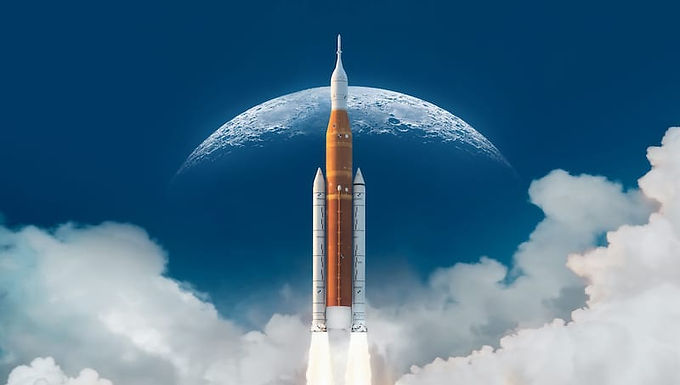
Artemis I, the first mission on NASA’s roadmap back to the Moon, has now canceled three launch days and experienced several more minor delays. The launch promises to send the unmanned Orion capsule on a journey around the Moon, paving the way for future missions that will land the first woman and person of color on the lunar surface.
The Artemis I mega moon rocket consists of a six-person Orion capsule perched atop the 30-story Space Launch System (SLS). It was initially scheduled to embark on its maiden voyage to the moon and back on August 29; however, various technical difficulties on two successive launch days prevented the rocket from taking off. NASA scrubbed the rocket's first attempt because engineers were unable to cool one of the rocket's four core stage RS-25 engines to a safe temperature before liftoff. Attributing the failure to a faulty temperature sensor, NASA quickly rescheduled the launch to September 3rd. During the rocket’s second attempt to launch, an alarm sounded as its supercooled liquid hydrogen fuel was being loaded on board, alerting engineers to a gap in the seal of one of the rocket's engines (a similar reason to why the Challenger blew up). Engineers tried and failed to plug the leak three times before again canceling the launch. The most recent delay was due to Hurricane Ian as the storm approached the rocket’s launch point at the Kennedy Space Center in Florida. NASA, 50 years after the Apollo missions, struggles to get a test rocket, named for Apollo’s sister and a patron of the moon, off the ground.
If Artemis I does succeed, the next era of crewed space exploration will begin. The Artemis program is planned to eventually lead the first human to set foot on Mars. Earlier this year, NASA released its "Moon to Mars" objectives, which identify 50 key points that fall under the categories of exploration, transportation and habitation, moon and Mars infrastructure, as well as operations and science. "These objectives will move us toward our first analog Mars mission with crew in space and prepare us for the first human mission to the surface of the Red Planet," Jim Free, associate administrator for NASA's Exploration Systems Development Mission Directorate, said in a statement in May. The advantage of using the moon as a stepping stone to Mars is the Moon’s proximity to Earth. A crewed mission can get to or from the moon in just three days, while a mission straight from Earth to Mars would take at least seven months, with a round-trip mission to the red planet estimated to last 500 days. With what Artemis can bring to the table, there could be options where missions will begin to launch from the Moon to Mars.
So hopefully, for the sake of all future astronauts, astrophysics, engineers, and anyone else in the astronomy field (some who could be at this school right now), the next attempt to travel to the moon and back is successful. You know what they say: fourth time’s a charm…
References
Lea, R. (2022, August 24). The Artemis plan: Why NASA sees the moon as a stepping stone to Mars. Space.com. Retrieved November 5, 2022, from
https://www.space.com/artemis-1-moon-stepping-stone-mars
Mishchenko, T. (2022, October 2). NASA's Artemis 1 rocket launch delayed again, probably till November. Mezha. Retrieved November 5, 2022, from
https://mezha.media/en/2022/10/02/nasa-artemis-1-rocket-launch-delayed-again/ Turner, B. (2022, September 15). NASA announces third launch attempt date for its 'mega moon rocket'. Life Science. Retrieved November 5, 2022, from
https://www.livescience.com/artemis-1-third-launch-attempt-announced