Rainbows of Sound
Haldora Churchill '27
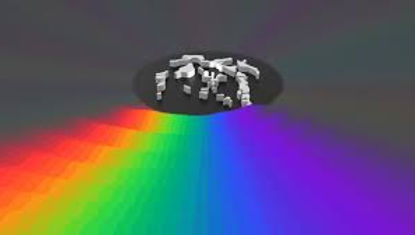
You may have heard of using a prism to filter light into a visible light spectrum, but did you know that you can do the same with sound? The Acoustic Rainbow Emitter (ARE) is a 3D-printed device that acts like a prism for sound, allowing you to input white noise and separating the different pitches into spectral components based on the frequency of each sound wave (Christiansen, R.E., et al, 2025). This revolutionary device was developed in mid-June of 2025 in Denmark by physicist Rasmus Christiansen and his team, having the potential to regulate room acoustics, among other functions (Christiansen, R.E., et al, 2025).
A monopolar source within the device, or a point from which force is distributed equally in all directions, emits white noise for the ARE to process and create the sound’s “rainbow.” The monopolar source produces noise from 8-13 kilohertz, which are high frequencies for human hearing—the highest note on a piano is around 4 kilohertz—to enable researchers to make a small acoustic device, as lower notes have longer wavelengths and would require the device to be much larger in order to process each sound wave (Conover, E, 2025). Specifically, ARE is close in size to a human ear, rendering it too small to handle lower notes with longer wavelengths. To do so would require a much larger device (Conover, E, 2025). The sound waves emitted from ARE are compared to a “rainbow,” which is typically used in describing visible light on the electromagnetic spectrum, which constitutes a rainbow.
Aiming to manipulate all the different wavelengths of sound within the ARE, Christiansen and his team used a computer model to simulate how each wave would interact with each other, revising their model until their sound field resembled a rainbow. The method they used is called computational morphogenesis, which involves the manipulation of forms and is inspired by the biological process through which an organism develops its complex structures (Christiansen, R.E., et al, 2025). ARE’s design was influenced by the complex structure of human ears. It is made up of variably shaped pillars that reflect sound waves and creates either constructive or destructive interference, guiding the waves to their exact locations (Christiansen, R.E., et al, 2025). Constructive and destructive interference means that the waves either reinforce or cancel each other out, affecting the amplification of different pitches at different locations within the device.
The idea for this ARE was influenced by how certain animals, such as bats, use different frequencies of sound to communicate, a phenomenon known as echolocation. Up until now, however, scientists have failed to replicate such a complex acoustic system because they typically require an active process of transforming white noise into a complete rainbow of pitches, instead of a passive form of scattering of sound waves. Through their research, Christiansen and his team also aimed to shed light on the lesser-known area of spatio-spectral sound decomposition, which is a form of data analysis that enables scientists to separate the spatial and spectral components of sound waves. (Nikulin, V., et al 2025). The scientists worked to design structures that can fully control the spatio-spectral decomposition of emitted or received sound without needing a source to actively produce sound.
The recent innovation of the ARE is significant in the world of physics, particularly in the study of sound, which has only recently emerged as a popular field of study. This device has allowed scientists to use their extensive knowledge of light waves in order to further the understanding of sound waves. Moreover, this device has been instrumental in helping scientists begin to understand the phenomenon of echolocation and how organisms effectively use it to communicate. Now, you can’t just see a rainbow, you can hear one too!
References
Conover, E. (2025, August 14). This device creates rainbows of sound. ScienceNews. https://www.snexplores.org/article/acoustic-sound-rainbow-device
Christiansen, R. E., Fernandez-Grande, E., & Sigmund, O. (2025, June 11). Morphogenesis of sound creates acoustic rainbows | science advances. Morphogenesis of sound creates acoustic rainbows. https://www.science.org/doi/10.1126/sciadv.ads7497
Nikulin, V. V., Nolte, G., & Curio, G. (2011, April 15). A novel method for reliable and fast extraction of neuronal EEG/MEG oscillations on the basis of spatio-spectral decomposition. ScienceDirect. A novel method for reliable and fast extraction of neuronal EEG/MEG oscillations on the basis of spatio-spectral decomposition
Dumé, I. (2025, July 10). Acoustic rainbows emerge from novel sound-scattering structure. Physics World.
https://physicsworld.com/a/acoustic-rainbows-emerge-from-novel-sound-scattering-struct ure/