Scientists Printed a Tiny 3D Elephant Inside a Cell
Aarav Shah '28
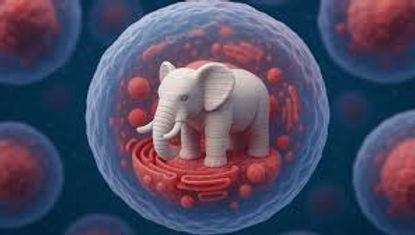
Exploring engineering structures inspired by organisms’ bodies is not a newfound concept, but one that has existed for many years. The development of 3D printing began in 1980, when Hideo Kodama uncovered ultraviolet light’s potential to harden materials (González, 2020). Nineteen later, the Wake Forest Institute of Regenerative Medicine produced a 3D-printed, lab-grown urinary bladder used for organ transplant surgeries (González, 2020). The question thus arises: how did the scientists 3D print a solid object in a cell without killing it?
Previously, researchers thought that they could engineer cells to engulf solid materials in a process called phagocytosis, rather than trying to force the material into the cells (Conover, 2025). While this method was effective for certain cell types, its limited applicability spurred the next logical question: how can these objects and materials be placed into a broader range of, if not all, cell types? (Conover, 2025).
This inquiry led researchers to explore the applications of 3D printing within cells. Physicist Matjaž Humar and his colleagues employed a technique called two-photon polymerization (Conover, 2025). This procedure first involved inserting a photoresist, a type of resin, into the respective cells (Conover, 2025). Afterwards, the photoresist was solidified by absorbing two photons—particles that make up light—from a laser (Conover, 2025).The extremely small focal volume of the laser not only ensured a high concentration of light but also allowed for exceptional detail in the 3D printed structures (Conover, 2025). Ultimately, with this strategy, the researchers successfully printed a miniscule elephant within an organism’s cell.
Beyond creating a tiny elephant, this innovation was also employed to print barcodes and microlasers into the cells themselves (Conover, 2025). The microlaser contains a sphere that
emits color when exposed to particles of light (Conover, 2025). This sphere assumes different shapes and sizes, as there will eventually be more ways to distinguish cells from one another (Conover, 2025). This technology opens up many possibilities for cellular identification, especially if colors could also be varied to enhance differentiation, thus presenting numerous potential applications within this new field of 3D printing inside cells.
A significant drawback of this 3D printing process, however, is the photoresist’s toxicity to many organisms (Conover, 2025). To resolve this problem, Humar and his colleagues attempted to develop a type of photoresist that would allow cells to survive using two-photon polymerization, which is a laser-based 3D printing technique (Conover, 2025). Based on their studies, some of the cells with the new photoresist divided and were able to transfer their 3D-printed design to daughter cells. Yet, after twenty-four hours had passed, 45% of the injected cells in a one sample had died (Shaikhnag, 2025). Consequently, in order to effectively reduce the toxicity of the photoresist, the two-photon polymerization 3D-printing technique would need to be further researched and enhanced (Conover, 2025).
Despite these challenges, the ability to 3D print designs within cells presents practical uses for scientists and doctors looking to target certain cells in treatment. As journalist Rupendra Brahambhatt claimed, “These tools could transform how [researchers] monitor and study cellular behavior in real time” (Brahambhatt, 2025). Furthermore, the ability to highlight certain cells can open up new possibilities in studying the interactions among cells. Lab work can oftentimes be tedious and repetitive, but the workload may potentially be reduced if scientists are able to flag certain cells in an organism with high efficiency.
References
Conover, Emily. (2025, July 8). Scientists 3-D printed a tiny elephant inside a cell. ScienceNews. Retrieved from https://www.sciencenews.org/article/3d-print-elephant-inside-cell. Brahambhatt, Rupendra. (2025, July 15). Scientists 3D Printed Microscopic Elephants and Barcodes Inside Cells for the First Time. Retrieved from
https://www.zmescience.com/science/news-science/3d-print-elephant-inside-living-cell/. Shaikhnag, Ada. (2025, July 21). What Happens When You 3D Print Inside a Living Cell? Scientists Found Out. Retrieved from
https://3dprintingindustry.com/news/what-happens-when-you-3d-print-inside-a-living-cel l-scientists-found-out-242045/.
González, Carlos M. (2020, January 30). Infographic: The History of 3D Printing. Retrieved from
https://www.asme.org/topics-resources/content/infographic-the-history-of-3d-printing.