The Smallest Walking Robot for Microscale Measurements
Sienna Kulynych '26
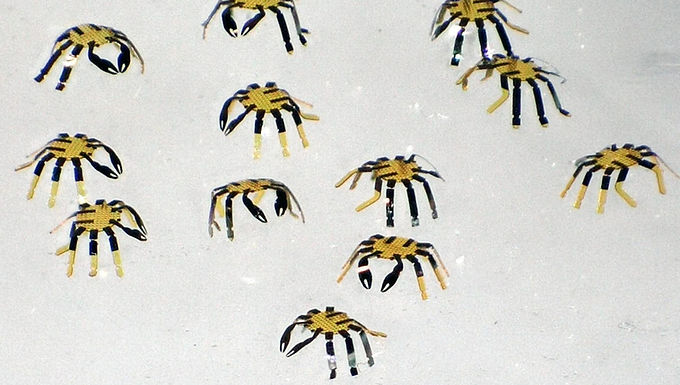
Researchers at Cornell University have created the smallest robot yet, capable of interacting with visible light waves while moving independently. Cornell scientists have exceeded their previous world record for the world’s smallest walking robot at 40-70 microns (smaller than the diameter of human hair) to robots at 2-5 microns (the size of bacteria particles). This breakthrough in diffractive robots could revolutionize microscopic imaging, allowing for advancements in force sensing, precise manipulation, and high resolution imaging on a scale previously inconceivable.
Microscopic robots have long been a goal in scientific research, with applications ranging from biomedical imaging to advancements in medical production and technology. The key innovation in these robots is their dependence on visible light diffraction, the bending of a light wave when it passes through an opening or around something. Combining this with imaging technology, the robot must be on a microscale for the optics to be enabled, and they have to move independently in order to reach what they are attempting to image. The Cornell scientists have managed to achieve both of these, allowing for advancement in not only the scale of the robot but also in effectiveness.
Since the robots are on such a small scale, they can only be controlled through a magnetic field. On solid surfaces, the robots inch-worm to move, controlled by magnets that make a pinching motion. In addition, they also are able to “swim” through fluids using the same motion. In order to magnetically drive the robots at this scale, the team used hundreds of nano-meter scale magnets with the same volume of material as the robots but with different shapes like long and thin, or short and stubby. These differing shapes are necessary as the long, thin ones require a larger magnetic field to flip them to other directions while the short, stubby ones need a smaller field. Knowing this, researchers can apply a larger magnetic field to get both shapes to align, but if they only want to flip the short, stubby ones, they only have to apply a smaller magnetic field.
The future applications of microscopic robots are endless. With the advancements in using the magnetic fields to control the robots, scientists are able to measure forces too.
Force-measurement and the robot's new optical abilities can be applied in research such as explorations in the structure of DNA and tissues. They can also be employed in fields like diagnostics and medical sensing. The Cornell scientists have significantly advanced the field of robotics through their combination of diffractive optical technology and maneuverability.
References
Biba, J. (2023, December 18). Microrobotics: Uses and Examples | Built In. Retrieved from builtin.com website: https://builtin.com/robotics/microrobotics
Smallest walking robot makes microscale measurements | Cornell Chronicle. (2024). Retrieved February 19, 2025, from Cornell Chronicle website:
https://news.cornell.edu/stories/2024/12/smallest-walking-robot-makes-microscale-measu rements
Smart, C. L., Pearson, T. G., Liang, Z., Lim, M. X., Abdelrahman, M. I., Monticone, F., … McEuen, P. L. (2024). Magnetically programmed diffractive robotics. Science, 386(6725), 1031–1037. https://doi.org/10.1126/science.adr2177