Lab-Engineered Spinal Cords & Transplantation into Humans
Aaron Sambursky '27
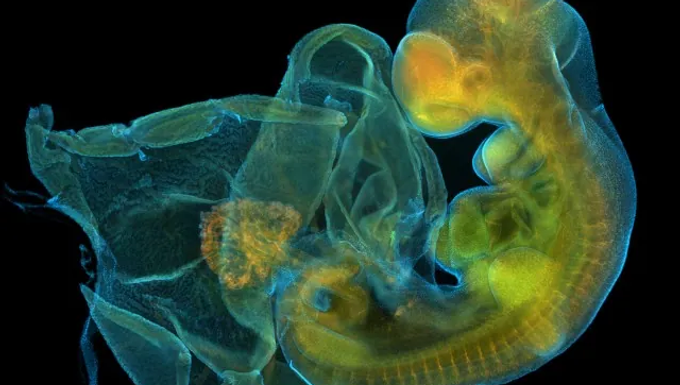
Scientists at The Francis Crick Institute in London have created an artificial notochord structure in a laboratory (Orf, 2025). The notochord is the temporary embryonic structure of tissues that helps in guiding an embryo’s spine and nervous system formation (Corallo et al., 2015). After analyzing chicken embryos and studying gene expression in mice and monkeys, scientists used human stem cell cultures to find the correct signaling pattern and timing necessary to create a model of notochord tissue out of stem cells (Rito et al., 2025). Ultimately, scientists created a tiny 3D structure that contained an arrangement of tissues and stem cells that mimics the arrangement found in human embryos (Rito et al., 2025). However, this structure is not an exact replica of human embryo structure (Orf, 2025). This lab-grown structure can activate chemical signaling pathways to organize tissue development as in a typical embryo (Rito et al., 2025). This breakthrough has particular significance because of its implications in studying the structure of vertebrae and designing synthetic tissue.
Ashley R. G. Libby and Tiago Rito took chick embryos and looked at their cells to map cell types (Rito et al., 2025). They found two main populations of progenitor cells: neuromesodermal progenitors and notochord progenitors (Rito et al., 2025). Neuromesodermal progenitors are bipotent cells that will become part of neural or mesodermal tissue while notochord progenitors will become part of the notochord—the structure that guides formation of the nervous system (Nature, n.d.). The scientists compared the chick embryos to those of mice and macaque monkeys and found similarity to gene expression of the progenitor cells (Rito et al., 2025). Progenitor cells are more specialized than stem cells because they cannot divide indefinitely, and they usually can only become a specific cell type (Gleichmann, 2024). Using in situ hybridization imaging, scientists mapped markers to find where these cells appear in actual embryos (Rito et al., 2025). Then, the scientists were able to recreate aspects of human spinal cord formation with stem cells and the induction of chemical signals (Rito et al., 2025).
Researchers found that the cells in the middle became more neural while cells on the outside became more mesodermal (Rito et al., 2025). In other words, cells at the center ended up becoming related to the brain and cells at the outside were more related to structure. Researchers saw that cells expressed an important notochord gene mainly at the outside ring of the stem cell colonies (Rito et al., 2025). More specifically, the researchers saw that phosphorylated ERK1 (pERK1) and phosphorylated ERK2 (pERK2) had been limited to the outside ring by 12 hours after adding the induction medium (Rito et al., 2025). This induction medium was a solution containing specific signaling molecules. It activated ERK1/2 and WNT and influenced YAP and TGFβ pathways (Rito et al., 2025). The effects of the induction medium were demonstrated by the phosphorylated ERK1/2 molecules (Rito et al., 2025). When a molecule is phosphorylated, a phosphate group is added to it and the molecule is either activated or deactivated (Sigma-Aldrich, n.d.). In this case, ERK1 and ERK2 (extracellular signal regulated kinases 1 and 2), important indicators of signal transduction and activation within cells, were activated by the induction medium (Rito et al., 2025). Shortly after, TBXT, an important notochord gene, was expressed, at first throughout the entire colony, but finally “localized to colony edges” by 24 hours following the addition of the induction medium (Rito et al., 2025). This expression of TBXT confirmed that cells had begun to mimic real embryos (Rito et al., 2025).
The correlation between pERK1/2 and TBXT expression that researchers found demonstrates the regulative signals involved in embryo structure formation. The researchers also found that TBXT expression was also affected by YAP activity and WNT signaling (Rito et al., 2025). YAP is essentially a protein that regulates notochord signals via TBXT expression, determining whether cells become part of the notochord or not. When YAP is inactive, expression of TBXT expression and notochord signals increase (Rito et al., 2025). When YAP is active, notochord signals decrease alongside TBXT expression (Rito et al., 2025). Together, YAP and ERK1/2 are part of signaling pathways that determine whether or not cells would express notochord gene activation (Rito et al., 2025). These patterns that the researchers saw are very important because they indicate the impact of signaling and gene regulation in cell organization.
This most significant finding of this experiment involves the timing of chemical signals. The induction medium initiated signaling and inhibitors were deliberately added later to regulate BMP and NODAL signals—pathways within the TGFβ family that help in designating stem cell development (Rito et al., 2025). While the induction medium activated ERK1/2 and began the process for notochord gene expression, scientists found that timing of the inhibiting TGFβ signals was extremely important in that process of notochord gene expression (Rito et al., 2025). The scientists carefully changed the timing of TGFβ signals (BMP and NODAL) by waiting 24 hours to add inhibitors to block BMP and NODAL pathways (Rito et al., 2025). This let cells be affected by the TGFβ signals initially—an important step to guide development—but then inhibited those signals and therefore allowed the cells to express notochord genes. The researchers found that if they inhibited the TGFβ signals too early or too late, the cells would not develop into notochord tissue (Rito et al., 2025). Introducing BMP and NODAL inhibitors too early prevented proper notochord formation, while introducing inhibitors too late led to alternate structure formation (Rito et al., 2025). This important discovery demonstrates the importance of timing in lab models and how timing can determine what structures are formed.
This study has significant implications in future research and medicine. Previous studies were limited in modeling the notochord within a lab, and this study has made significant advancements by creating a more complete model that better represents the different aspects of notochord development. This study can serve as a basis for future research on developmental conditions. Tiago Rito, the first author of the study said that the miniature lab-grown notochord “appears to function similarly to how it would in a developing embryo” as shown by the findings in this study (Orf, 2025). By finding the timing and signals required for notochord formation, the scientists have created an important model that will be very useful when studying human development and birth conditions (Perfetto, 2024). This breakthrough in embryo modeling may also support the development of other artificial models of embryo structures, allowing scientists to study early human development easier without ethical issues. Ultimately, this study involved significant breakthroughs that will shape medicine and how scientists study early human development.
References
Blue-White Screening & Protocols for Colony Selection. (2025). Merck, 1(1). https://www.sigmaaldrich.com/MX/en/technical-documents/technical-article/genomics/cl oning-and-expression/blue-white-screening
D, C., V, T., & P, B. (2015, August 1). The Notochord: Structure and Functions. Cellular and Molecular Life Sciences : CMLS. https://pubmed.ncbi.nlm.nih.gov/25833128/
Embryonic Development and Neuromesodermal Progenitors | Nature Research Intelligence. (2023). Nature.com. https://www.nature.com/research-intelligence/nri-topic-summaries/embryonic-developme nt-and-neuromesodermal-progenitors-micro-52139
Gleichmann, N. (2020, December 18). What are Progenitor Cells? Exploring Neural, Myeloid and Hematopoietic Progenitor Cells. Cell Science from Technology Networks. https://www.technologynetworks.com/cell-science/articles/what-are-progenitor-cells-expl oring-neural-myeloid-and-hematopoietic-progenitor-cells-329519
Orf, D. (2025, January 2). Scientists Have Grown a Human Spine In a Lab. Popular Mechanics. https://www.popularmechanics.com/science/health/a63241663/scientists-grow-human-spine/
Perfetto, I. (2024, December 19). Scientists grow a “notochord” for the first time in the lab. Cosmos. https://cosmosmagazine.com/science/biology/notochord-grown-in-lab-first-time/
Rito, T., Ashley, Demuth, M., Marie-Charlotte Domart, Cornwall-Scoones, J., & Briscoe, J. (2024). Timely TGFβ signalling inhibition induces notochord. Nature. https://doi.org/10.1038/s41586-024-08332-w