Artificial Intelligence in Medicine
Anvi Anand '27
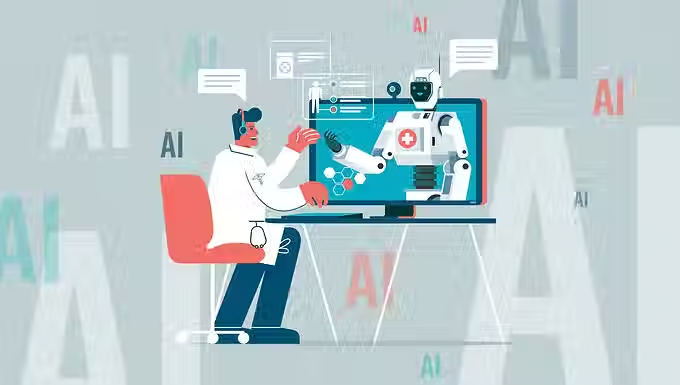
With a staggering 1,779% increase in worth from $1.1 billion in 2016 to $22.4 billion in 2023, the global market for artificial intelligence in medicine continues to grow rapidly in demand (Roy, 2024). AI has been in the medical industry since the 1970s, so what has changed for this rapid growth in the past decade? AI has revolutionized the concept of personalized medicine, contributing to its integration in Electronic Health Records (EHRs) and breakthrough drug discovery. However, AI in medicine still holds potential risks ranging from privacy breaches to biased data that should be kept in mind.
Starting with EHRs, these digital files hold a patient’s medical history, including their demographics, medical treatments, and test reports, which are vital for inexpensive and “efficient” communication across healthcare providers. In 2009, the Health Information Technology for Economic and Clinical Health Act (HITECH) financially incentivized medical professionals to adopt EHRs, causing their systems to be built in mass amounts with quantity prioritized over quality (Rose et al., 2024). Supposedly efficient, EHRs are known for their complex and outdated interface, overwhelming clinicians with navigational challenges and psychological burnout: the opposite of the resource’s goal. For an average physician, over 50% of clinical time is spent handling an EHR console, causing decreased job satisfaction with tasks composed of more data interaction than actual patient interaction (Rose et al., 2024). With human burnout comes a higher chance of missing important diagnoses and larger error rates: up to 20% of patients may be inaccurately matched to their EHRs, compromising medical safety for many individuals (Pallardy, 2024).
AI is being incorporated into software companies such as Epic Systems to decrease this clerical burden for physicians and make the efficiency of EHRs a reality. Epic has installed AI technology to produce SOAP notes (Subjective, Objective, Assessment, and Plan) during patient-provider appointments, with the notes covering what was discussed and sent to a physician to finalize. Used in over 30 sites, Epic’s head of research and development, Sumit Rana, revealed the results of “average savings of five-and-a-half hours per week,” with a 76% reduction in overtime hours for Epic clinicians (Siwicki, 2023). Additionally, AI can help draft responses to patient questions, still leaving space for providers to answer through their own text box. Rana admitted that their AI had been ‘empathetic’ as well, responding with emotive statements like “I'm sorry you're going through this, I hope your vacation has been good” (Siwicki, 2023). Busy physicians cannot always provide the same level of empathy in every comment, but with the aid of AI, anything is possible. Furthermore, AI algorithms have expanded their abilities to analyze EHRs, suggest potential diagnoses, and alert clinicians of abnormalities. These personalized tools allow for less burnt-out workers and more efficient and accurate services: a win-win for patients and providers.
During the coronavirus pandemic, drug discovery was in crisis but supported by AI. The drug chemical space holds more than novemdecillion (one followed by sixty zeroes) molecules, making drug discovery tedious and costly (Paul et al., 2020). Only some drugs realistically generate returns exceeding their development expenses: from 2000 to 2015, the price of a newly approved drug was $2.5 billion per single approved molecule, and it took up to 15 years for new drugs to reach the market (Floresta et al., 2022). For COVID-19, 15 years was not an option.
AI tools can be broken into four branches of machine learning (ML), natural language processing (NLP), automation and robotics, and machine vision. In the case of computer-aided
drug discovery (CADD), machine learning and generative AI have expedited the steps of drug design, screening, and repurposing. Proving helpful for predicting the 3D structure of virus-targeted proteins and their level of toxicity, AI speeds up the identification of possible “hit” molecules, molecules with the desired effect on these target proteins. Target proteins are often “drug targets,” as drugs are designed to modify the activity of these molecules. Synthetic, real-world datasets allow AI to test these respective drugs, requiring fewer tests on in-person participants and reducing trial costs and delays. As a result, AI has discovered drug compounds to combat SARS-CoV and SARS-CoV-2, coronaviruses that cause COVID-19, along with influenza and HIV viruses (Kaushik et al., 2020). All these diseases are now regulated by the available vaccines supported by AI to be brought from the bench to bedside and beyond.
Unfortunately, risks still lie in the intersection of artificial intelligence and healthcare, posing ethical and safety concerns for patients and providers. Large amounts of EHRs and data shared with AI can be perceived as a privacy violation for patients with the risk of being exposed to third parties. One precedent includes the incident of London’s Royal Free Hospital handing over 1.6 million medical records to Google and DeepMind to test a medical app (Ward-Brennan, 2024). Additionally, AI is deeply influenced by biased data, also known as the intentional poisoning of data. This algorithmic bias ends up privileging one arbitrary group over another, worsening healthcare disparities in patient groups to larger extents.
For medical providers, there are two sides of this spectrum: workers who over-rely on AI and those who do not know how to utilize the resource. If clinicians overuse this resource, human judgment can be lost and replaced with automation, which holds bias and unintended consequences. On the other hand, physicians who lack expertise on the inner systems of this tool can struggle to communicate with patients, causing unreliability and mistaken interpretations. AI
has advanced but is not capable of replacing these human jobs altogether, as it does not just come with benefits but disadvantages as well.
Though artificial intelligence has been hugely impactful in the medical world in the past few years, scientists continue to address the holes in its system. No human is perfect after all, so how can we trust AI to be?
References
Alowais, S. A., Alghamdi, S. S., Alsuhebany, N., Alqahtani, T., Alshaya, A., Almohareb, S. N., Aldairem, A., Alrashed, M., Saleh, K. B., Badreldin, H. A., Yami, A., Harbi, S. A., & Albekairy, A. M. (2023). Revolutionizing Healthcare: The Role Of Artificial Intelligence In Clinical Practice. BMC Medical Education, 23(1).
https://doi.org/10.1186/s12909-023-04698-z
Basu, K., Sinha, R., Ong, A., & Basu, T. (2020). Artificial Intelligence: How Is It Changing Medical Sciences and Its Future? Indian Journal of Dermatology, 65(5), 365–370. https://doi.org/10.4103/ijd.IJD_421_20
Chandra Kaushik, A., & Raj, U. (2020). AI-driven drug discovery: A boon against COVID-19? AI Open, 1, 1–4. https://doi.org/10.1016/j.aiopen.2020.07.001
Chustecki, M. (2024). Benefits and Risks of AI in Health Care: Narrative Review. Interactive Journal of Medical Research, 13, e53616–e53616. https://doi.org/10.2196/53616 Floresta, G., Zagni, C., Gentile, D., Patamia, V., & Rescifina, A. (2022). Artificial Intelligence Technologies for COVID-19 De Novo Drug Design. International Journal of Molecular Sciences, 23(6), 3261. https://doi.org/10.3390/ijms23063261
Pallardy, R. (2024). Electronic Health Record Errors Are a Serious Problem. Www.informationweek.com.
https://www.informationweek.com/data-management/electronic-health-record-errors-are a-serious-problem
Paul, D., Sanap, G., Shenoy, S., Kalyane, D., Kalia, K., & Tekade, R. K. (2020). Artificial Intelligence in Drug Discovery and Development. Drug Discovery Today, 26(1), 80–93. ncbi. https://doi.org/10.1016/j.drudis.2020.10.010
Rose, C., & Chen, J. H. (2024). Learning from the EHR to implement AI in healthcare. Npj Digital Medicine, 7(1). https://doi.org/10.1038/s41746-024-01340-0
Roy, S. (2024, October 21). AI in Healthcare Statistics: Comprehensive List for 2025. Dialog Health. https://www.dialoghealth.com/post/ai-healthcare-statistics
Siwicki, B. (2023, November 28). How Epic is using AI to change the way EHRs work. Healthcare IT News.
https://www.healthcareitnews.com/news/how-epic-using-ai-change-way-ehrs-work Synthetic Data in Drug Development - What it is and How it Relates to AI-informed Approaches. (2023, May 19). Verisimlife.com.
https://www.verisimlife.com/publications-blog/synthetic-data-in-drug-development-what it-is-and-how-it-relates-to-ai-informed-approaches
Ward-Brennan, M. (2024, October 21). NHS: Google faces appeal over data deal with London’s Royal Free. City AM.
https://www.cityam.com/google-faces-appeal-over-patient-data-deal-with-nhs-londons-ro yal-free-hospital/