Self-Driving Laboratories: Letting the Lab Discover
Emily Wu '28
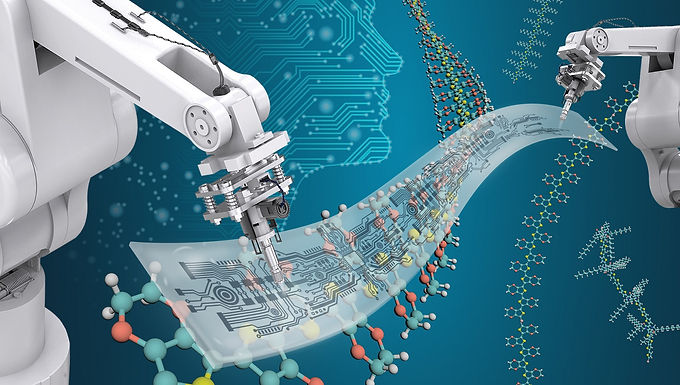
For centuries, scientific discovery has always relied on manual experimentation; the stereotypical scientist using flasks and graduated cylinders to measure substances step-by-step often comes to mind. While that approach has led to many major breakthroughs, the tiresome work of trial and error hinders the speed and efficiency at which research progresses. Recent technology has allowed laboratories to adopt automated systems within their practices, transforming how experiments are designed, conducted, and analyzed. As a result, self-driving laboratories (SDLs) have emerged as a promising new development in the scientific industry, allowing research to be conducted with minimal human intervention. Implementing SDLs into modern research, however, comes with both benefits and challenges.
Self-driving labs are scientific workspaces that utilize automated tools and equipment to perform research. Four key components of the loop outline the SDL's experimental process: design, make, test, and analyze. When designing an experiment, SDLs first use AI software and algorithms to set up experimental objectives and processes. Then, robotic hardware in the lab, like robotic arms and liquid handlers, perform the steps of the experiment that the software has outlined. After the final products of the experiment are produced, the robotic equipment collects the data and sends it back to the software for analysis. Subsequently, the software also analyzes ways the experiment can be improved to increase the efficiency and effectiveness of its processes. In contrast to other automated labs, this step is ultimately what makes SDLs unique because they have the ability to refine their own methods without human intervention. By iteratively learning from each cycle, SDLs optimize productivity in the scientific work field.
SDLs offer multiple benefits to researchers who are trying to make breakthroughs and identify new developments in the scientific field. For one, SDLs provide a major advantage in reducing developmental costs and waste by collecting data up to ten times faster than regular methods. The accelerated data generation allows complex algorithms and AI software to identify unsuccessful projects early on, allowing companies to conserve time and materials for future approaches. Additionally, its automated systems can move a lot more efficiently in complex lab spaces compared to humans, significantly increasing efficiency and minimizing room for error. Not only does this feature optimize resource allocation for both companies and employees, but it also promotes the broader idea of a more sustainable environment for research.
SDLs also play a critical role in knowledge retention. Since all necessary coding, algorithms, and software can be found and are stored permanently online, it is nearly impossible to lose the expertise needed in the research field. This system becomes especially important because nearly one-third of the experienced workforce is expected to retire by 2030, potentially losing or slowing the use of important expertise while companies are still in the process of making significant discoveries. As a result, companies can worry less about losing expertise in the workforce now that new technology helps set a safeguard by allowing for expertise to be easily transferred to newer employees.
However, employees begin to face a dominating issue with AI when they realize that SDLs may replace the need for humans in the research process completely. In fact, 52% of laboratory professionals think that new automated systems developed in the workplace threaten their jobs. The resistance of current lab employees has in part limited the adoption of SDLs in the workforce, and companies may choose not to implement these types of labs at all.
Despite their benefits, self-driving labs also present several practical and organizational challenges for companies. For instance, in older companies and systems, it can be harder to implement modern technology simply because there are legacy constraints, and it would take a lot of resources to initiate the SDLs. That places these companies at a lower advantage in comparison to modern companies, which can integrate these technological advancements with ease. On top of that, if companies were to implement SDLs in the workplace, employees would need to be properly trained in order to ensure that the equipment is used responsibly and safely. It is definitive that once SDLs are in place, humans still maintain control of the environment and prevent unintended consequences. Thus, while SDLs may seem like the best technological advancement in research, their challenges must still be addressed before they can become widely used in the world.
Self-driving labs have the potential to transform research and development for the better, such as reducing costs, promoting sustainability, and preserving critical knowledge. At the same time, SDLs have constraints and need fully trained employees to oversee the entire process and ensure public safety. While SDLs prove to be a major step in innovation, companies must balance their advantages and responsibility to fully maximize their potential. Therefore, as artificial intelligence continues to reshape the scientific field, the real question is not whether SDLs will change research, but whether we will change with them.
References
World Economic Forum Annual Meeting. (2024, January 4). What are self-driving laboratories and how are they transforming the #chemical industry?. World Economic Forum. https://www.weforum.org/stories/2024/01/self-driving-labs-transforming-chemical-industry/
Santiago-Sosa, D. J. (2025, June 18). Damián J. Santiago-Sosa. Athens Science Observer. https://athensscienceobserver.com/2025/06/18/laboratories-running-by-themselves-the-er a-of-ai-and-the-rise-of-self-driving-lab/
Kim, Y. (2025, December). Self-driving laboratories with artificial intelligence: An overview of process systems engineering perspective. Science Direct.
https://www.sciencedirect.com/science/article/abs/pii/S0098135425002698
North Carolina State University. (2025, July 14). This AI-powered lab runs itself-and discovers new materials 10x faster. ScienceDaily.
https://www.sciencedaily.com/releases/2025/07/250714052105.htm
Media. (2024, July 30). New survey reveals burnout in Clinical Labs impacts patient care, staff safety; optimism that automation, AI will help tackle challenges. Global Press Release & Newswire Distribution Services.
https://www.businesswire.com/news/home/20240730284940/en/New-Survey-Reveals-Bu rnout-in-Clinical-Labs-Impacts-Patient-Care-Staff-Safety-Optimism-that-Automation-AI Will-Help-Tackle-Challenges