Sleep & Brain Discoveries
Yvonne Li '28 & Sophie Yang '29
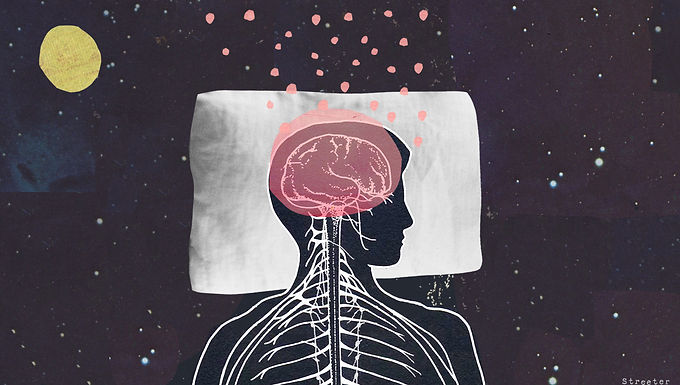
Unraveling the Mystery of Dreams: How the Brain Functions During Sleep Yvonne Li ’28, Sophie Yang ’29
Dreams have fascinated humans for centuries, inspiring a wide range of mythical interpretations and early theoretical explanations. Historically, people speculated about the nature and purpose of dreams, since dreams cannot be observed, but only heard about through external reports. Yet, with the advancement of technology, scientists can now study dreams with empirical testing instead of speculation. Ongoing research continues to expand our knowledge of the complex mental experiences that occur during sleep. Specifically, scientists investigate why humans dream by examining brain activity during sleep with laboratory technologies, revealing that dreams are closely tied to waking experiences shaped by memories and emotions.
Although many may not remember their dreams, we dream every night. For many years, researchers have investigated what actually happens in the brain during dreaming. Initial studies explored dream content and frequency (Ruby, n.d.). Since then, new experiments have uncovered many internal and external factors that can affect dreams (Ruby, n.d.). In 1981, a group of scientists, Timothy J. Hoelscher, Eric Klinger, and Steven G. Barta, introduced a variety of verbal stimuli to a group in Stage 2 sleep and Rapid Eye Movement (REM) sleep. Spanning 10 to 25 minutes, Stage 2 sleep allows the body to relax and the heart rate to slow; on the other hand, REM sleep is when the brain performs memory repair and emotion processing. The group found that the human subjects’ dreams incorporated the verbal stimuli more than other ideas (Hoelscher et al., 1981). Thus, a main hypothesis was formed based on these results: The themes of a subject's life are similar to what they might encounter in dreams (Schredl and Hofmann, 2003).
Then, two studies between 2003 and 2004 found that males reported more violence and aggression in their dreams than females. Additionally, the results showed that the surroundings
or recent concerns of the subject could affect what happened in their dreams (Koulack, 1969; Saint-Denys, 1867; Hoelscher et al., 1981; Schwartz, 1999; Domhoff and Schneider, 2008). People often report memories of dreams after awakening during REM, suggesting that dreams occur during the REM stage of sleep. Specifically, subjects recalled dreams resembling “vivid, sensorimotor hallucinatory experiences that follow a narrative structure” (Nir & Tononi, 2010). Interestingly, a subject will almost always forget their dreams unless they wake up during REM sleep, although that dream is also quickly forgotten (Nir & Tononi, 2010). Emotional and vivid contents in dreams often occur during the REM stage, which plays an important role in processing waking experiences through emotional consolidation (Scarpelli et al., 2019).
Neuroimaging studies show how processes that regulate dreaming and emotions during sleep share similar neural substrates that control emotions when we are awake (Scarpelli et al., 2019). Gamma activity, a pattern of high frequency (30-80 Hz) neuron fluctuations, is also related to the emotional processes and dream recall (Scarpelli et al., 2019; Jia & Kohn, 2011). Many parts of the brain are active during dreaming. As the brain’s outer layer, the cortex is responsible for the content of dreams (Blackmore, n.d.). Since dreams represent a predominantly visual phenomenon, the visual cortex is especially active during dreams. Contrastingly, the frontal lobes—responsible for personality and decision making, along with judgement and emotional regulation—are among the least active parts of the brain (Blackmore, n.d.). During dreams, people tend to be uncritical of and receptive to the events that occur, which explains the relatively inactive state of the frontal lobes (Blackmore, n.d.). Polysomnography (PSG) serves as one of the most essential technologies used for dream research, helping scientists identify the distinct stages of sleep (Wong et al., 2025). The PSG exam includes three tests: the electroencephalogram (EEG), which measures brain activity; the electrooculogram (EOG), which measures eye movement; and the electromyogram (EMG), which measures muscle activity (Wong et al., 2025). Among them, EEG is the most essential. EEG detects electrical activity in the brain with electrodes—small metal discs—attached to the participants’ scalps (Mayo Clinic, 2024). The rapid waves of electric impulses are then recorded as wave-like patterns on EEG recordings (Wong et al., 2025). These recordings allow researchers to monitor the participants’ stage of sleep (i.e. rapid eye movement or non-rapid eye movement), so the researchers can wake the participants at the right time for dream reports (Wong et al., 2025). Some participants recall specific dream contents, while others remember having a dream without recalling any details; some report no experience upon awakening (Wong et al., 2025). Through this approach, researchers examined whether the EEG patterns could predict the presence of dreaming based on the participant’s stage of sleep (Wong et al., 2025).
With this new technology, researchers identified a “posterior hot zone” in the parieto-occipital region of the cerebral cortex that is responsible for conscious experiences during sleep (Wong et al., 2025). The observation that certain participants awakened with dreams during non-REM stages of sleep challenges the traditional belief that dreams occur only in REM sleep (Wong et al., 2025). The recollection of a dream is linked to a reduction in low-frequency EEG activity in the posterior regions of the cortex, while an increase in higher frequency EEG activity in the same region was associated with the participants’ ability to recall the specific contents of their dreams (Mapping the Brain during Sleep Yields New Insights on Dreaming and Consciousness, n.d.).
Furthermore, EEG studies indicate heightened emotion processing during nightmares (Scarpelli et al., 2019). Actively revisiting and modifying frightening dream content during lucid dreams—dreams when you are conscious and aware that you are dreaming—is an effective
method used to treat nightmares, as it gives the person control over their dream and reduces the nightmares’ emotional intensity (Scarpelli et al., 2019). Additionally, new scenarios with positive emotional elements may also be created during dreams to cope with nightmares (Scarpelli et al., 2019).
During sleep, the brain also plays a key role in consolidating new memories into long-term storage. Elements of recent experiences often appear in dreams (Wamsley & Stickgold, 2011). Animal research shows that pre-sleep experience replays in sleep, influencing the content of dreams (Wamsley & Stickgold, 2011). In the past, sleep and dreaming were thought to primarily strengthen newly formed memories (Wamsley & Stickgold, 2011). Yet, earlier studies only focused on simple measures such as word recall or pattern recognition (Wamsley & Stickgold, 2011). Since then, scientists have discovered that sleeping can help integrate new information into established cortical memory networks, which are interconnected neurons in the cerebral cortex (Wamsley & Stickgold, 2011).
Importantly, sleep holds the potential to transform memories. In a 2011 study, participants learned a list of related words, and when they were asked to recall the list of words after sleeping, they remembered the “gist” words, not the exact list of words they were given (Wamsley & Stickgold, 2011). These findings suggest that sleep preferentially preserves the general meaning of an experience rather than its specific details (Wamsley & Stickgold, 2011). Additionally, sleep improves learning, since the sleeping brain can reactivate memories that have occurred during the day, which results in dreams (Wamsley & Stickgold, 2018).
While discussing the purpose of dreams, Mark Blagrove from Swansea University said that “dreams were meant to be shared socially and evolved in humans to enhance emotional intelligence and empathy” (Bloxham, 2024). Likewise, at the 2024 International Association for
the Study of Dreams annual conference, researchers discussed embodied cognition theory of dreaming, which states that dreams prepare the subject for occurrences that may happen in conscious, everyday life (Bloxham, 2024). As mentioned before, it is extremely difficult to research the exact purpose of dreams, but recent studies have given scientists a potential direction to follow.
Overall, dreams are mysterious phenomena that everyone experiences on a daily basis, with a healthy adult spending a third of their life sleeping (Aminoff et al., 2011). If people were to know the purpose of dreams, they could use them as a tool to help them succeed in their daily lives. Although understanding the specific brain activities during dreaming have proven to be difficult, scientists are conducting more research to decipher how the brain functions during sleep. Most dreams are forgotten instantly or within ten minutes of waking up, which makes understanding the science of dreams ever so important. After all, once dreams are forgotten, they are gone forever.
References
Aminoff, M. J., Boller, F., & Swaab, D. F. (2011). Foreword. Handbook of Clinical Neurology, vii. https://doi.org/10.1016/b978-0-444-52006-7.00047-2
Blackmore, S. (n.d.). What happens when we dream? BBC Science Focus. Retrieved December 24, 2025, from
https://www.sciencefocus.com/the-human-body/what-happens-when-we-dream Bloxham, A. (2024, August 30). Four breakthroughs that are changing our understanding of dreams. The Conversation. Retrieved December 24, 2025, from
https://theconversation.com/four-breakthroughs-that-are-changing-our-understanding-of dreams-236286
EEG (electroencephalogram). (2024, May 29). Mayo Clinic.
https://www.mayoclinic.org/tests-procedures/eeg/about/pac-20393875#:~:text=EEG%20 brain%20activity-,EEG%20brain%20activity,the%20time%2C%20even%20during%20sl eep
Hoelscher T. J., Klinger E., Barta S. G. (1981). Incorporation of concern- and nonconcern-related verbal stimuli into dream content. J. Abnorm. Psychol. 90, 88–91
10.1037/0021-843X.90.1.88
Jia, X., & Kohn, A. (2011). Gamma Rhythms in the Brain. PLoS Biology, 9(4), e1001045. https://doi.org/10.1371/journal.pbio.1001045
Nir, Y., & Tononi, G. (2010, January 14). Dreaming and the brain: from phenomenology to neurophysiology. National Library of Medicine. Retrieved December 24, 2025, from https://pmc.ncbi.nlm.nih.gov/articles/PMC2814941/
Ruby, P. M. (n.d.). Experimental Research on Dreaming: State of the Art and Neuropsychoanalytic Perspectives. National Library of Medicine. Retrieved December 24, 2025, from https://pmc.ncbi.nlm.nih.gov/articles/PMC3220269/
Scarpelli, S., Bartolacci, C., Gorgoni, M., De Gennaro, L., & D'Atri, A. (2019, March). Investigation on Neurobiological Mechanisms of Dreaming in the New Decade. National Library of Medicine. Retrieved January 9, 2026, from
https://pmc.ncbi.nlm.nih.gov/articles/PMC7916906/#:~:text=Many%20findings%20point ed%20out%20that,further%20deepening%20in%20future%20research
Wamsley, E. J., & Stickgold, R. (2012, March 1). Memory, Sleep and Dreaming: Experiencing Consolidation. National Library of Medicine. Retrieved January 9, 2026, from https://pmc.ncbi.nlm.nih.gov/articles/PMC3079906/
Wamsley, E. J., & Stickgold, R. (2020, February 1). Dreaming of a Learning Task is Associated with Enhanced Memory Consolidation: Replication in an Overnight Sleep Study. National Library of Medicine. Retrieved January 9, 2026, from
https://pmc.ncbi.nlm.nih.gov/articles/PMC3079906/
Wong, W., Herzog, R., Andrade, K.C. et al. A dream EEG and mentation database. Nat Commun 16, 7495 (2025). https://doi.org/10.1038/s41467-025-61945-1