Use of AI and LLMs in Political Science and Journalism
Lily Truong '26
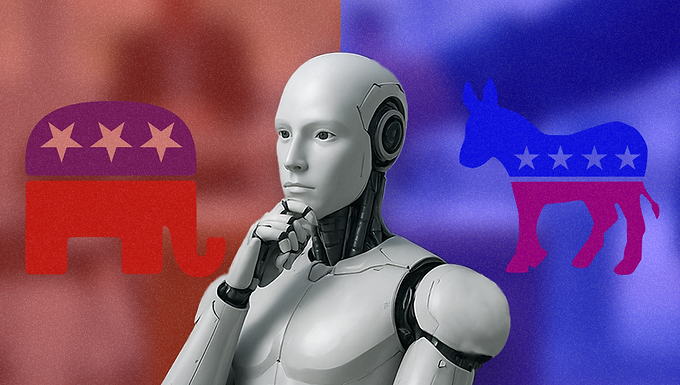
Large Language Models (LLMs) are a recent generation of artificial intelligence (AI) that have increasingly transformed the fields of journalism and political science. News organizations such as The Associated Press have used AI tools to automatically generate corporate earnings reports, while political campaigns like the Republican National Committee’s 2023 "Beat Biden" advertisements have employed fully AI-generated images and scriptwriting. In academic research, LLMs have enabled political scientists to analyze thousands of legislative speeches and public statements rapidly, identifying trends that would take months or years to uncover manually. These applications demonstrate how AI is already reshaping how information is produced, analyzed, and communicated.
LLMs in particular are an advanced AI system that trained on large text datasets to generate and analyze human-like language. The introduction of ChatGPT in 2022 was a breakthrough in the use of LLMs in many fields. By late 2023, many major news organizations had established rules and formal guidelines in terms of using ChatGPT in this line of work (Merrifield, 2023). This paper will examine the current application of AI and LLMs in journalism and political science. This discussion will explore a broad range of developments in AI rather than a single project, reflecting the wide range of applications on using artificial intelligence.
Historically, artificial intelligence in journalism has been used in limited ways such as news organizations using algorithms to automate basic reporting tasks since the 2010s. For example, the Associated Press (AP) began using an automated system to write thousands of corporate earnings reports each quarter—over ten times more than reporters produced
previously—freeing up human journalists to focus on deeper analysis (Associated Press, 2014).
Early “robot journalism” systems generated short updates on sports scores, weather, and even minor earthquakes within minutes of an event, following pre-programmed templates (Lokot & Diakopoulos, 2016). However, these uses have only been narrow and single task focused. By contrast, modern LLMs can produce narrative text and handle more language based tasks. In current newsrooms, AI tools are being piloted not just to write data-driven stories, but also to assist with research, translation, and content creation in more nuanced ways. Many media outlets now experiment with LLM-based assistants for journalists, using them to summarize lengthy documents, suggest headlines, or generate rough drafts of news articles under editor supervision. In one survey of 52 news organizations across the world, 44% explicitly allowed journalists to use AI for tasks like gathering information and developing story outlines, while only 4% outright forbade such uses (Becker et al., 2023). Smaller newsrooms have found particular value in these tools: The Baltimore Times has used AI image generators to create illustrations for stories, and The Haitian Times uses an AI assistant to identify expert sources and do first-pass editing of articles (Merrefield, 2025). These applications can help local and starter news teams to produce quality content with limited resources.
Despite the technical advances, there are major issues with the accuracy and ethics in the use of AI. Generative AI models are prone to “hallucinations,” meaning they can produce false or fabricated information that looks credible. About 69% of major newsroom AI policies have warned staff about the risk of AI tools introducing factual errors (Becker et al., 2023). A high-profile example underscored this risk in early 2023, when the tech outlet CNET attempted to publish AI-written financial articles. The experiment backfired when observers discovered numerous factual mistakes and even apparent plagiarism in the AI-generated content, prompting
CNET to issue corrections and pause its use of the AI writer (Christian, 2023). Such incidents highlight the need for human factual checks. In response, many newsrooms require that any AI-generated material be verified and transparently disclosed. Roughly 90% of news organizations with AI guidelines mandate that the use of AI in producing content be revealed to readers (Becker et al., 2023). Editors often treat LLM outputs as first drafts or research aids rather than the final copy, ensuring that journalists remain responsible for accuracy and journalistic standards. The consensus in the industry is that AI can augment reporting by handling routine or labor-intensive tasks while reporters focus on interpretation, investigation, and original reporting: roles that demand human judgment and creativity. As stated in a report by the Associated Press, automating straightforward news stories allows journalists to “do more journalism and less data processing,” concentrating on what the numbers mean rather than merely relaying them (Associated Press, 2014). With this method, AI is used as a tool for aid, not to replace another human.
AI and LLMs are predicted to have even more major impacts on journalism in the future. News content creation could become increasingly automated for certain kinds of reports. It is possible that within a few years, news briefs—such as stock market updates, sports recaps, or traffic and weather alerts—will be routinely generated by AI systems trained on real-time data. Major outlets have already signaled plans to expand AI-written coverage in areas like local business reports and sports, areas where template-based AI writing has succeeded in the past. At the same time, more sophisticated generative models might enable on-the-fly translation and personalization of news. A recent example comes from local journalism during a crisis: when wildfires struck Los Angeles in 2024, a community newsroom called Boyle Heights Beat used an AI-based translation tool to publish critical safety information simultaneously in English and
Spanish, helping reach a bilingual audience quickly (Mendoza, 2025). This “bilingual bridge” project relied on an LLM to translate and adapt content, illustrating how AI can improve coverage for diverse communities. In the upcoming years, news organizations may employ AI to tailor news delivery to individual readers. As an example, algorithms could be used to assemble personalized news digests or answer readers’ questions via news chatbots. If these trends continue, the line between human-written and AI-generated news may blur in problematic ways. Industry experts predict that as generative AI tools become integrated into newsroom workflows, audiences will increasingly encounter content that has had some level of AI involvement, whether in writing, editing, or presentation (Marconi et al., 2023). One recent analysis noted that the 2024 election cycle is likely the first where “ads full of images generated by modern AI software” and even news reports aided by AI were part of the media landscape (Thompson, 2023). Journalistic norms of verification, attribution, and disclosure will serve as crucial safeguards. This blurring of sources will make transparency all the more important.
In the realm of political science, AI and LLMs are creating new approaches to both research and practice. Academic researchers have been using and relying more on LLMs to analyze heavy chunks of political texts and data. The field of political science has traditionally relied on qualitative analysis and quantitative statistics to study legislative behaviour, policy outcomes and public opinion. With LLMs, the collection of data in speeches, documents, and news articles can be done more efficiently. Artificial intelligence can detect patterns and comb through data that can majorly aid researchers.. Recent work by a multidisciplinary group of researchers highlights that LLMs have already been applied to tasks such as election prediction, sentiment analysis of political communication, policy impact assessment, and even detecting misinformation in the political world (Zhang et al., 2023). These applications illustrate how AI
can perform political analysis: an election forecasting model might incorporate social media sentiment analyzed by an LLM, or an LLM might be fine-tuned to recognize propaganda in online content. Importantly, LLMs enable multi-language analysis. Political scientists can use translation-capable AI systems to analyze texts across different languages and regions, expanding the scope of comparative studies. With these tools, scholars are gaining deeper quantitative insight into areas like political ideology in manifestos, discourse patterns on social media, and the evolution of policy rhetoric over time.
Beyond academia, AI has begun to influence real-world politics and campaigns. Political strategists are experimenting with AI for campaigning, voter outreach, and polling. In April 2023, the Republican National Committee (RNC) released what was billed as the first entirely AI-generated campaign advertisement by a major U.S. party. This online video, titled "Beat Biden," depicted a dystopian future scenario in the event of President Biden’s reelection – using AI-generated images and voices to create realistic “but fictional” breaking-news scenes of domestic and international crises (Thompson, 2023). The RNC confirmed the ad was 100% AI-made. In the coming election cycles, it is expected that there will be more AI-generated campaign materials. Just like how AI can tailor news for specific individuals in journalism, the same can be done for political campaigns. Hypothetically, a national campaign could use an LLM to instantly generate dozens of variations of a political flyer or social media post, each one customized with local references and targeted policy points for different voter demographics (Linegar et al., 2023). A presidential campaign might produce personalized video ads addressing the concerns of voters in different regions – something previously too costly to do for every small community. This level of micro-targeting, powered by AI can be proven to be very powerful. On one hand, it could help candidates speak more directly to the interests of niche
constituencies. On the other, it raises the risk of “parallel narratives” and misinformation. As mentioned before, hallucinations are a common occurrence and without human fact checkers may lead to more misinformation.Researchers note that LLMs and related generative tools have “dramatically reduced the costs of producing highly realistic and seemingly real content,” which could be exploited to create fake campaign ads or misleading news designed to manipulate voters (Linegar et al., 2023). An implication of this misuse could be an actor using an AI system to generate a counterfeit news report that falsely claims a candidate dropped out of a race, or a fake audio clip of a politician taking an extreme position. As another hypothetical scenario, an AI could spread instructions that mislead voters – one study imagined a subtle disinformation campaign where an AI agent tells voters in certain areas to “print their name on the ballot” in places where doing so would actually invalidate the vote, potentially disenfranchising thousands (Korner et al., 2023). These possibilities have put electoral integrity experts on high alert. In response, platforms and regulators are starting to develop safeguards (for instance, watermarking AI-generated media or requiring disclosures in political ads) to mitigate the most harmful uses.
In conclusion, AI and large language models have been and will continue to change and explore the possibilities in the realm of journalism and political science. Despite this, these developments come with serious responsibilities. Both journalists and political scientists must approach AI with ethical considerations to prevent misinformation, bias, and maintain transparency. The next few years will likely see even deeper integration of LLMs into these fields, making it crucial to establish best practices and oversight now. If guided thoughtfully, AI can enhance the pursuit of truth in journalism and the understanding of political processes. Achieving that balance will determine whether AI’s growing presence ultimately strengthens media integrity and democratic governance.
References
Associated Press. (2014, July 2). AP replaces reporters with automated system to produce company results. The Guardian. Retrieved from
https://www.theguardian.com/media/2014/jul/02/associated-press-automated-journalism (Original AP announcement summarized by Greenslade, R.)
Becker, K. B., Lauerer, C., & Strauß, J. (2023). Generative AI policies in newsrooms: A comparative analysis of 52 news organizations’ guidelines. (Working paper). Summarized in: Merrefield, C. (2023, December 12). Researchers compare AI policies and guidelines at 52 news organizations around the world. Journalist’s Resource. Retrieved from https://journalistsresource.org/home/generative-ai-policies-newsrooms/
Christian, J. (2023, January 23). CNET’s AI journalist appears to have committed extensive plagiarism. Futurism. Retrieved from https://futurism.com/cnet-ai-plagiarism Linegar, M., Kocielnik, R., & Alvarez, R. M. (2023). Large language models and political science. Frontiers in Political Science, 5, Article 1257092.
https://doi.org/10.3389/fpos.2023.1257092
Marconi, F., Murgia, M., Beckett, C., et al. (2023). AI and the future of news: Challenges and opportunities. Reuters Institute for the Study of Journalism, University of Oxford. Interviewed in: Cherubini, F. (2023). Is ChatGPT a threat or an opportunity for journalism? [Panel discussion]. Retrieved from Reuters Institute website.
Mendoza, D. (2025, February 27). From Puerto Rico to California: How AI helped deliver critical information in two languages during the LA fires. American Journalism Project (Medium). Retrieved from
https://medium.com/american-journalism-project/from-puerto-rico-to-california-how-ai-h elped-deliver-critical-information-in-two-languages-during-6589ab49ebe6 Merrefield, C. (2023, December 12). Researchers compare AI policies and guidelines at 52 news organizations around the world. Journalist’s Resource (Harvard Kennedy School). Retrieved from https://journalistsresource.org/home/generative-ai-policies-newsrooms/ Merrefield, C. (2025, March 4). AI in the newsroom: What researchers learned from the AP and the BBC. Journalist’s Resource (Harvard Kennedy School). Retrieved from https://journalistsresource.org/home/ai-ap-bbc/
Sanders, N., Schneier, B., Berger, A., & Gong, E. (2024, June 27). Using AI for political polling. Ash Center for Democratic Governance and Innovation, Harvard University. Retrieved from https://ash.harvard.edu/articles/using-ai-for-political-polling
Thompson, A. (2023, April 25). First look: RNC slams Biden in AI-generated ad. Axios. Retrieved from
https://www.axios.com/2023/04/25/rnc-slams-biden-re-election-bid-ai-generated-adno Wu, S., Gao, J., & Choi, Y. (2023). Political-LLM: Large Language Models in political science – opportunities, challenges, and guidelines. arXiv preprint arXiv:2308.XXXX. Referenced in: Political-LLM.org (2023). Retrieved from https://political-llm.org/ (Abstract and introduction).